Pet Water Fountains: The 2026 Honest Buyer's Guide
Moving water can help a cat or dog drink more — but only the right fountain does. Material, pump noise and cleaning decide if yours gets used or gathers dust.
By 2k50 Tech Team
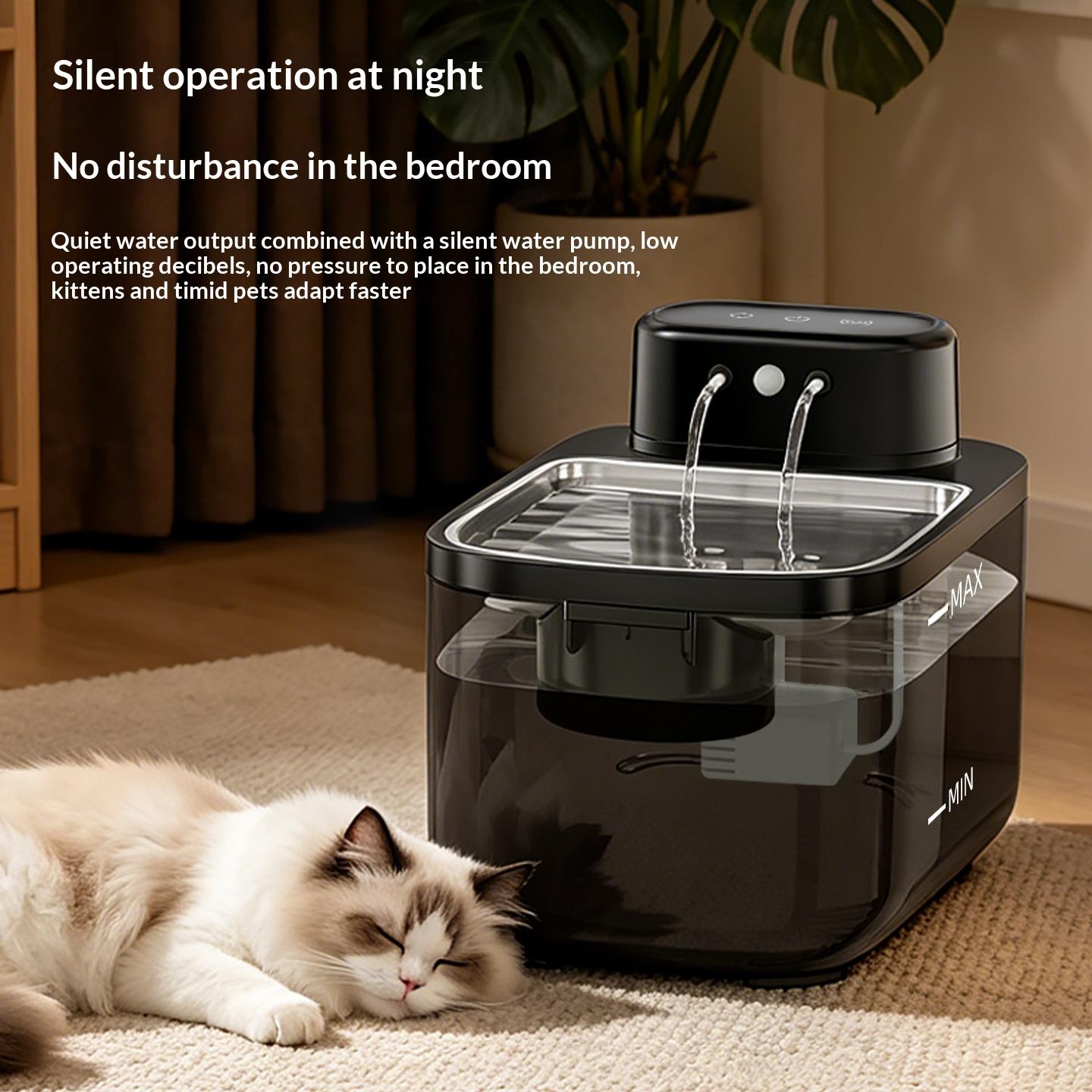
Most cats don't drink enough water. That single fact drives the entire pet fountain market — and it also drives a lot of bad buying decisions. A fountain can genuinely help a reluctant cat drink more, and it can just as easily become a $70 appliance that gathers dust in a corner while your cat goes back to the tap.
This guide explains how fountains actually work, what the evidence says about hydration, and the seven decisions that determine whether the one you buy gets used. It covers cats and dogs, every price tier, and the maintenance reality nobody puts on the box.
Do Pet Water Fountains Actually Work?
Short answer: for cats, usually yes. For dogs, maybe — and often it doesn't matter.
Cats evolved in arid environments, getting most of their moisture from prey. That history left them with a famously weak thirst drive. Studies suggest up to 60% of indoor cats drink less than half the water they should, and chronic low intake is linked to urinary tract problems and kidney disease — two of the most common reasons cats visit the vet.
A 2015 study published in the *Journal of Feline Medicine and Surgery* found that cats given flowing water drank 15–20% more over two weeks than cats using still bowls, with the effect strongest in older cats and those with early kidney disease. Vets report similar turnarounds in practice, especially for cats on dry food. The mechanism is straightforward: moving water looks and sounds fresh, it stays oxygenated, and it triggers an instinct cats never lost — in the wild, running water is safer than standing water.
Dogs are a different story. The American Kennel Club quotes Carlo Siracusa, DVM, an associate professor of clinical animal behavior at the University of Pennsylvania: "I'm unaware of evidence supporting the theory that dogs prefer running water." Dogs generally drink when they're thirsty, and a bowl works fine for most of them. A fountain can still help a dog that loves garden hoses and taps, or one that prefers cool water — circulation keeps the temperature consistent — but don't buy one expecting a dog to suddenly drink twice as much.
The honest framing: a fountain is a hydration *nudge*, not a medical device. If your cat is already drinking well from a bowl, a fountain adds little. If your cat ignores still water, drinks from taps, or has a history of urinary issues, it's one of the cheapest interventions worth trying. And if your vet has already flagged kidney values or urinary crystals, ask them first — a fountain supports a hydration plan, it doesn't replace one.
How Much Water Does a Cat or Dog Actually Need?
You can't judge a fountain without a target. Veterinary guidance (VCA Hospitals) puts a cat's baseline at roughly 4 ounces of water per 5 pounds of body weight per day — so a 10-pound cat needs about 8 ounces, roughly one cup. Other veterinary sources give a similar range of 3.5–4.5 ounces per 5 pounds.
Two things complicate that number. First, wet food is 70–80% water, so a cat eating mostly wet food may drink very little from a bowl and still be fine. A cat on dry food alone needs to drink nearly all of its water. Second, hot weather, exercise, and illness all raise the requirement.
Signs your pet may be under-drinking: dry or sticky gums, skin that stays tented when gently pinched, lethargy, and — for cats — infrequent urination or straining in the litter box. None of these diagnose anything on their own, but together they're worth a vet visit, fountain or no fountain.
How a Pet Water Fountain Works
Every fountain is the same three parts doing the same job:
That circulation is the whole point. Still water in a bowl collects dust, grows a slimy layer of bacteria (biofilm) within a day or two, and tastes stale. Moving, filtered water stays fresher longer and — crucially for cats — is visible and audible, which is what draws them to it in the first place.
The 7 Things That Decide Whether a Fountain Gets Used
1. Material: stainless steel or ceramic beats plastic
This is the single most important decision, and it's where cheap fountains fail.
Plastic is light, cheap, and everywhere — but it scratches. Those microscopic scratches harbor bacteria, and the slimy biofilm that grows in them is linked to feline chin acne and skin irritation around dogs' muzzles. Plastic also holds odors over time, and some cats simply refuse to drink from a bowl that smells wrong to them.
Stainless steel is non-porous, rust-resistant, and the easiest material to sanitize. Ceramic is equally hygienic and heavier, so it stays put when a large dog bumps it — but it can chip or crack if dropped. Vets consistently favor stainless steel and ceramic over plastic for long-term use.
If your budget only stretches to plastic, that's fine — buy it, but clean it more often and replace it sooner. If you can spend $10–20 more for a stainless or ceramic model, do it. It's the best money in this entire purchase.
2. Pump noise: quiet is not a luxury
A noisy fountain scares cats away from drinking. Full stop. The pump is the part that makes or breaks the habit, and cheap pumps gurgle, hum, or rattle — especially as the water level drops and the pump starts sucking air.
Look for a pump rated under 30 decibels; the best ones run under 20 dB, which is quieter than a whisper. Check owner reviews specifically for noise complaints at low water levels, not just on day one. A fountain that's silent when full and gurgling when half-empty will train your cat to avoid it.
Also check whether the pump is easy to remove and clean. PetSafe's own documentation recommends cleaning the pump every two weeks, and a pump you can't take apart is a pump that will die early. Typical pump lifespan runs from 6 months to 4 years depending on brand and maintenance — cleaning is what pushes it toward the long end.
3. Capacity: match it to your household
Too small and you're refilling every day, which defeats the purpose. Too big and the water sits for a week getting stale.
A water-level window is a small feature with outsized value: it lets you see when a refill is due without taking the lid off. Multi-pet homes should also look for a wide drinking surface or 360-degree access, so two animals can drink at once without crowding each other.
4. Filtration: budget for the filter bill, not just the fountain
Most carbon filters need replacing every 2–4 weeks. That's a recurring cost of roughly $1–3 per filter, or $15–40 a year depending on the brand — and replacement filters must be the right size for your model, so check availability and price before you buy the fountain, not after.
Some newer models are filterless, using a separation system that divides clean water from wastewater. These cost more upfront but eliminate the recurring filter bill. For most buyers, standard replaceable filters are fine — just don't treat them as optional. A filter that's rinsed and reused instead of replaced stops filtering, and a clogged filter strains the pump.
One honest note: fountain filters remove hair, debris, and some odor and taste. They do not purify water the way an under-sink filter does. If your tap water is poor, the fountain won't fix it — filter the water before it goes in.
5. How easy it is to clean
Here's the question that decides whether your fountain is still in use in six months: will you still be cleaning it in six months?
Fountains need a full clean weekly — reservoir scrubbed, pump rinsed, filter changed on schedule. Hair and slime build up in every crevice, and a fountain with a dozen small parts takes three times as long to clean as one with four. When comparing models, count the parts. Fewer, larger pieces win. Dishwasher-safe components are a genuine plus.
This is also why material matters so much: a stainless or ceramic bowl scrubs clean in seconds, while a scratched plastic reservoir never quite feels clean again. The best fountain is the one with the shortest cleaning routine you'll actually do every week.
6. Corded vs cordless
Corded fountains are cheaper and never run out of power, but the cable is a chew target and a trip hazard, and the fountain has to live near an outlet. Look for a chew-resistant cord and a cable-routing channel if you have a puppy or a curious kitten.
Cordless, battery-powered fountains (usually USB-rechargeable) can sit anywhere — away from the food bowls, which matters, because many pets avoid drinking near where they eat. The tradeoff is battery life: most need recharging every few days to a couple of weeks, and a dead battery means still water until you notice.
If your pet already has a favorite drinking spot away from an outlet, cordless is worth the premium. Otherwise, corded is simpler and cheaper.
7. Flow style: match the stream to the pet
Cats have preferences, and they're not shy about them:
If you don't know your cat's preference, a model with adjustable flow covers the most ground — start gentle and increase it. And remember that whisker fatigue is real: a narrow, deep bowl forces whiskers against the sides, which many cats hate. A wide, shallow drinking surface is kinder and gets used more.
Fountain vs Bowl: An Honest Comparison
| Factor | Water fountain | Regular bowl | |---|---|---| | Water movement | Continuous circulation | Still, stagnates within a day | | Freshness | Filtered, oxygenated, stays appealing | Collects dust and biofilm quickly | | Pet attraction | High for cats, variable for dogs | Familiar, but often ignored | | Hydration impact | Cats often drink 15–20% more | Depends on owner diligence | | Cleaning effort | Weekly full clean, pump maintenance | Quick daily rinse | | Ongoing cost | Filters every 2–4 weeks | None | | Failure modes | Pump dies, power out, filter clogs | None — a bowl can't break | | Price | $18–250 | $5–15 |
The bowl wins on simplicity and reliability. The fountain wins on freshness and, for cats, on intake. The right answer for many homes is both: a fountain as the main source and a plain bowl kept clean and topped up as backup — which the American Kennel Club also recommends, since a backup bowl covers power outages and pump failures.
What to Spend: Price Tiers in 2026
Budget ($18–30): This is where most first-time buyers should start. The Catit Flower Fountain (~$28–30) is the classic entry point — three flow settings, 100 oz capacity, and a design most cats accept on day one. The tradeoff is plastic construction and a more hands-on cleaning routine. At the same end of the market, a simple filtered circulating fountain with a quiet pump can be found for under $20, such as the [2k50 Smart Circulating Pet Water Fountain](https://www.2k50.store/product/cj-prod-2092900563680145409) ($17.56), which pairs a quadruple filter with a silent-flow pump — a reasonable way to test whether your cat will use a fountain at all before spending more.
Mid-range ($40–75): The sweet spot for most households. The PETLIBRO Dockstream (~$70) is the most recommended model in this tier — a stainless steel top, near-silent pump, and a design that comes apart easily for cleaning. The PetSafe Drinkwell Platinum (~$75) is the pick for multi-cat homes, with a 168 oz reservoir. The NPET WF210Plus (~$22) is the outlier here: stainless steel at a budget price, with a full gallon of capacity and a water-level window, though its long-term pump reliability is less proven than the bigger brands.
Premium ($70–100): Ceramic territory. The PetSafe Drinkwell Pagoda (~$91) is the best-known ceramic fountain — 70 oz, quiet, and heavy enough to stay put. The MISFANS Ceramic Fountain (~$70) earns its recommendation from a deep track record and an all-ceramic body with a copper spout. Buy ceramic if hygiene is your top priority and you want the easiest cleaning routine in the category.
Smart ($150–250): The PETKIT Eversweet Ultra (~$250) adds a camera that logs which cat drank and how much, plus app control and wastewater separation. It's genuinely useful for one specific job: tracking an individual cat's intake when a vet has asked you to. For everyone else, a cat that drinks from a $22 steel fountain drinks exactly the same amount from this one. Don't pay for the camera unless someone — your vet — asked you to.
Who Should Skip a Fountain
Not every home needs one. Skip it if:
The First-Week Checklist
Fountains fail most often in the first seven days, when the pet is deciding whether this new thing is safe. Get the week right:
1. Place it away from the food bowl. Many pets avoid drinking near eating zones — put the fountain in a quiet corner, ideally where your pet already likes to drink. 2. Keep the old bowl full next to it. Give your pet a choice, and a fallback. Remove the bowl only after the fountain is clearly the preferred source. 3. Start on the gentlest flow. A strong stream on day one startles nervous cats. Increase it gradually. 4. Let them investigate. Don't push your pet's head toward the water. Curiosity does the work — most cats try it within 24–48 hours. 5. Top it up daily for the first week. A low water level makes the pump gurgle, and one bad noise experience can put a cat off for good. 6. Do the first full clean on day seven. It sets the weekly habit, and it shows you how long cleaning actually takes — if it takes more than ten minutes, you bought the wrong fountain.
The Bottom Line
A pet water fountain is worth buying when a cat under-drinks, ignores still water, or drinks from taps — and when the owner buying it will clean it every week. The material matters more than the brand, the pump matters more than the app, and the cleaning routine matters more than either.
Spend $20–30 to find out whether your cat will use one. Spend $70 if you want stainless steel or ceramic that stays hygienic with minimal effort. Spend $250 only if your vet asked you to track intake. And whatever you buy, keep a plain bowl beside it — the simplest backup is still the one that never breaks.
*Sources: American Kennel Club, "Could Your Dog Benefit From Using a Pet Water Fountain?"; Catster, "11 Best Cat Water Fountains in 2026"; Journal of Feline Medicine and Surgery (2015), flowing-water intake study; VCA Hospitals, feline water requirements. Prices checked November 2026 — verify current specs and prices before buying.*