Screenless Health Bracelets: The 2026 Buyer's Guide
Screenless health bands promise medical tracking for dinner money. What they actually measure, how accurate they are, and what to check before buying in 2026.
By 2k50 Tech Team
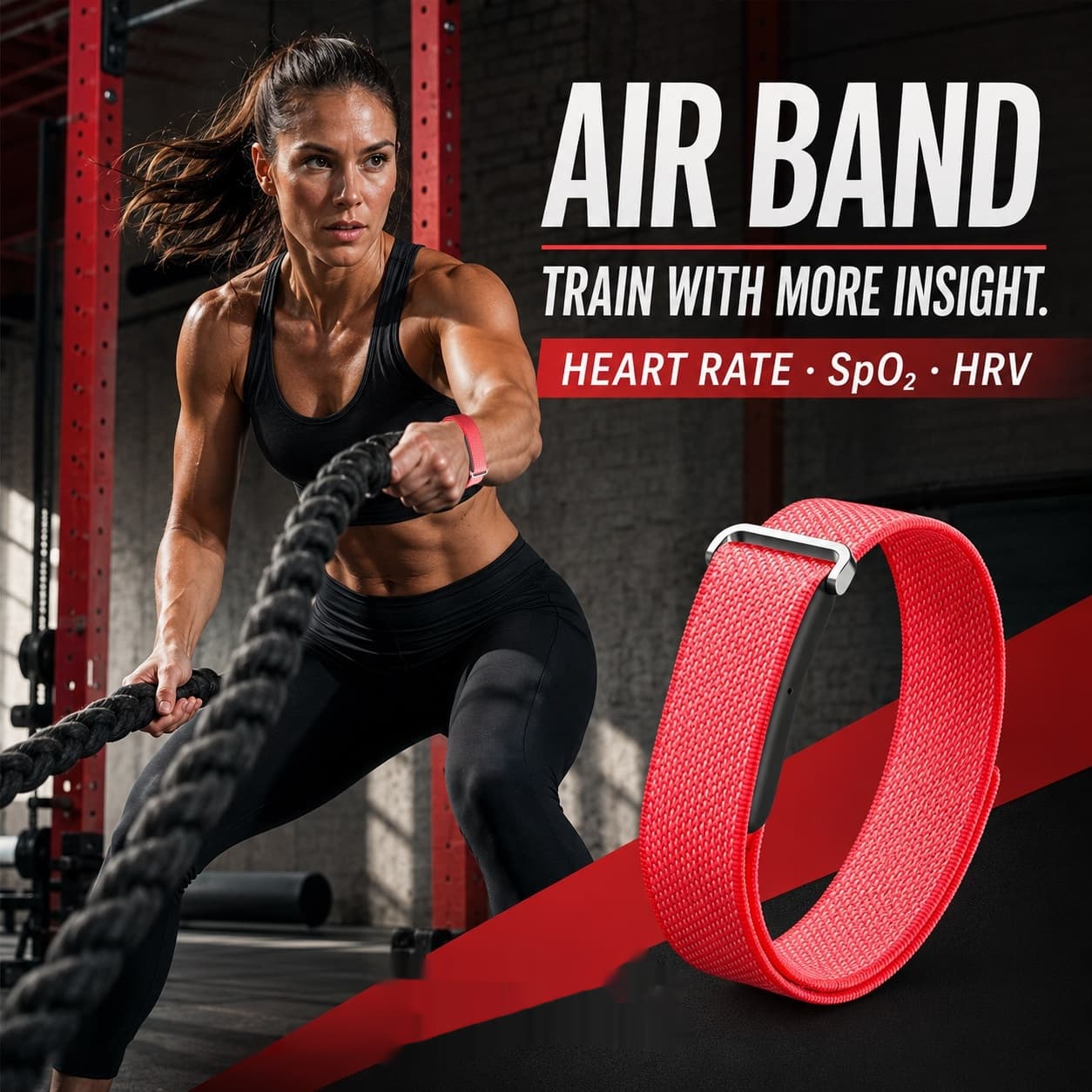
The screenless health bracelet is the quietest corner of the wearable market. No glowing display, no notifications buzzing at dinner, no watch face to customize — just a slim band with sensors that quietly log your heart rate, sleep, and activity around the clock, then hand the data to your phone. Fitbit's 2026 Air band — a $99.99 screenless tracker built to compete with Whoop — pulled the whole category back into the spotlight. But you don't need to spend anywhere near that much: basic models with heart-rate, blood-oxygen, and sleep sensors now sell for $30–$60.
The catch is that a $40 band and a $400 smartwatch are both "health trackers" in name only. They measure similar things, but how much of what they show you can actually be trusted — and which of their numbers matter — is a very different story. This guide explains what these cheap bands actually measure, how accurate they are, the five things to check before buying one, and who should skip them entirely.
How the guide was put together
This is not a sponsored roundup and no manufacturer supplied a device. It's built from three sources: peer-reviewed validation studies of wrist-worn sensors (compared against chest straps, pulse oximeters, and sleep labs), independent hands-on test reports from 2025–2026 published by Wareable, Tom's Guide, Live Science, Tech Advisor, and Wirecutter-style testing outlets, and teardown-level specs of the budget band category. Where the science disagrees with marketing, the science wins.
What a screenless health bracelet actually is
Strip away the marketing and a screenless health bracelet is three things: a battery, a set of optical sensors, and a Bluetooth radio. That's it.
The sensor core is a photoplethysmography (PPG) module — a green or infrared LED plus a light detector pressed against your wrist. Blood absorbs green light, so as blood volume pulses through your wrist with each heartbeat, the reflected light flickers in rhythm. From that flicker the band derives your heart rate. Adding red and infrared LEDs lets it estimate blood-oxygen saturation (SpO2) by comparing how much of each wavelength is absorbed. An accelerometer and gyroscope read motion for steps, activity, and the stillness that suggests sleep.
What's missing compared to a smartwatch: no display (you read everything in the phone app), no built-in GPS (distances are estimated from your stride, not satellites), no speakers or microphone, and usually no payment chip. What's added: battery life of 10–14 days instead of 1–2, a lighter, thinner body you can genuinely sleep in, and a much lower price.
It's worth knowing the category's family tree. Budget smart bands like Xiaomi's Smart Band 10 (Tech Advisor's "Best New Fitness Tracker of 2025–26") dominate with a display at ~$30–$50. Screenless bands — the 2k50 store's Smart Health Tracking Bracelet at $51.06, Fitbit Air at $99.99, Whoop at the premium end — are the minimalist branch: same sensors, no screen, betting that you'll trade glanceability for comfort and battery life.
How accurate are cheap health bands? Metric by metric
This is the question every budget shopper asks, and it's where honest reviewing earns its keep. The short answer: surprisingly good for a few metrics, shaky for others. The long answer, metric by metric:
Step counting — very reliable. Wrist accelerometry is a solved problem. Independent tests consistently find budget trackers within a few percent of reference devices for everyday walking. If steps are your main metric, a $40 band does the job.
Resting heart rate — good. This is the metric cheap optical sensors do best at. At rest, multiple reviewers found budget bands from Xiaomi, Amazfit, and Fitbit landing within 1–5 BPM of a chest strap (chest straps use electrical ECG sensing and hold the ±1 BPM gold standard). One budget-band roundup measured Xiaomi trackers within 5% of a chest strap during steady cardio. The catch: you must wear the band snugly, about two fingers above the wrist bone. Loose bands let light leak in, and the readings fall apart.
Heart rate during intense exercise — mediocre. This is where the budget tier visibly breaks. Rapid arm movement, sweat, and motion artifacts confuse optical sensors. Budget bands under $20 tested in 2026 showed accuracy swings of 10–15% during HIIT-style workouts compared to chest straps. Premium wrist wearables hold up better, but no wrist optical sensor beats a chest strap during intervals. If you're training seriously, a $40 band's live HR is a rough guide, not a training instrument.
Sleep tracking — good for duration, approximate for stages. Every reviewer lands in the same place: modern bands are quite good at detecting *when* you fell asleep and *how long* you slept, but rough at sorting your night into light, deep, and REM stages. Validation research against clinical sleep studies (polysomnography) puts sleep-vs-wake detection around 80% accurate and sleep-stage identification near 60%. Sleep-lab comparisons for popular screenless and band devices show the same pattern: high sensitivity for sleep, low specificity for wake, moderate stage agreement. The practical takeaway is one reviewers repeat like a mantra: trust the trend, not the minute. A band is excellent at showing whether you're sleeping more or less consistently over weeks. It cannot diagnose anything about your sleep architecture.
Blood oxygen (SpO2) — useful directionally, never medical. Wearable SpO2 uses the same principle as hospital pulse oximeters but with smaller sensors and far less validation. Readings are affected by skin pigmentation, cold hands, tattoos, and fit; plausible sea-level values run 95–100%. Budget trackers have held up reasonably against flagships in head-to-head tests, but no $50 band's SpO2 reading should inform a medical decision. Track the overnight trend; ignore any single alarming number.
Calories burned — educated guesses. Every wearable estimates calories from algorithms mixing your age, weight, heart rate, and activity. They're estimates, consistently off by meaningful margins in validation studies. Use them to compare workouts against each other, never as a budget for food.
"Wellness" versus medical. One line of legal reality: consumer wearables are wellness devices, not medical devices. They are not validated to medical standards, and regulators require the distinction. A band can legitimately raise awareness of your sleep and activity patterns — sleep-medicine societies explicitly endorse that use — but it is not a diagnostic tool. See a doctor for loud snoring, gasping, or daytime exhaustion, not your band's app.
What budget bands genuinely get right
Where they disappoint (and how to spot it early)
The app is half the product. This is the single most common budget-band failure mode, and the one no spec sheet reveals. A great sensor with a crashing, ad-stuffed, or abandoned app is a brick with a battery. Before buying anything, open the App Store or Google Play page of the companion app and read recent reviews: crash reports, lost data, login walls, and untranslated menus are all red flags. Established brands (Xiaomi's Mi Fitness, Zepp) have years of app investment behind them; obscure brands often do not.
No GPS means no real run tracking. Bands without satellite GPS estimate distance from your steps and stride length — fine on a treadmill, optimistic outdoors. If you care about running or cycling routes and pace, you need a watch with GPS, or you accept your phone riding along.
Water resistance is not swimming clearance. Many budget bands carry IP68 (dust-tight, survives submersion) but that rating doesn't certify lap-swimming or hot-tub use. If swimming matters, look for 5ATM.
Specs are sometimes fiction on unbranded bands. Inflated battery claims, copy-pasted "medical-grade" language, and feature lists the hardware can't support are endemic at the cheapest end of the market. If a listing can't name the sensor or the app, walk away.
The 5-point checklist before you buy
1. Name the sensors. A legitimate listing says what it measures: PPG heart rate, SpO2, accelerometer, sleep analysis. Vague "smart health" wording with no sensor detail is a warning. 2. Vet the companion app. Check its store rating and recent reviews. The hardware spec means nothing if the app loses your data. 3. Confirm subscription-free. Make sure sleep analysis, sport modes, and exports are included without a monthly fee. If a subscription unlocks the data, the true price is much higher. 4. Match the battery to your patience. 10–14 days is the honest budget standard; claims far above that are usually measured with everything disabled. 5. Check the return policy. Fit and sensor quality vary unit to unit in this price tier. Buy from a seller with a real return window.
Who should buy one — and who should skip
Buy if: you want a low-maintenance habit lens — steps, sleep consistency, resting heart-rate trends — without notifications, subscriptions, or nightly charging. Screenless bands are arguably the best *sleep* trackers for the money simply because you'll actually wear them to bed.
Skip if: you need accurate workout heart rate (get a chest strap), real GPS (get a GPS watch), medical-grade confidence in any number (talk to a doctor), or you check your wrist 50 times a day (you want a smartwatch, and that's fine).
Reading your data like a scientist
The highest-value skill a band owner can learn has nothing to do with hardware: it's how to read the numbers. Use 7–14 day averages, not single days. Watch resting heart rate and sleep consistency — those trends genuinely reflect recovery and stress. Ignore day-to-day wobbles in sleep stages, calorie counts, and single SpO2 dips. And when the app shows a scary-sounding "recovery score," remember the honest limit no marketing copy mentions: no randomized trial has ever shown that following a wearable's readiness score improves a health outcome. These tools raise awareness; awareness is what you act on.
A concrete example of the category
To put a price on all of this: the Smart Health Tracking Bracelet sold through the 2k50 store at $51.06 sits squarely in the budget tier described here — screenless design, PPG heart-rate and blood-oxygen sensors, sleep and activity tracking via a companion app, and no subscription. It's representative of what $50 buys in 2026: real sensors, honest battery life, app-dependent experience. Before adding any band at this price to a cart, run it through the five-point checklist above — the band passes the spec test, but the app vetting step is yours to do.
The bottom line
A cheap screenless health bracelet is one of the best value propositions in wearables right now: a few dollars a month buys you continuous, low-friction insight into your sleep and activity habits, with resting heart-rate tracking that's genuinely accurate. It's not a medical device, it's not a training computer, and the app matters as much as the hardware. Buy it for trends, wear it snugly, charge it twice a month, and you'll get exactly what the honest version of the marketing promises — nothing more, nothing less.